
Water-Conscious Planting and Efficient Landscape Irrigation at Syarif Hidayatullah State Islamic University Jakarta
Syarif Hidayatullah State Islamic University Jakarta promotes water-conscious planting through efficient irrigation technologies, water reuse, green landscape development, and institutional water-conservation practices. The University recognises that vegetation and green spaces provide important environmental benefits but can also create significant water demand when irrigation is not managed efficiently.
To address this challenge, Syarif Hidayatullah State Islamic University Jakarta combines landscape development with technologies and practices intended to reduce unnecessary freshwater consumption. During 2024–2025, these initiatives included sensor-based irrigation technologies, the reuse of ablution water for landscape irrigation, expanded campus vegetation, and Green Campus water-management measures.
These activities contribute to Sustainable Development Goal 6: Clean Water and Sanitation, particularly Indicator 6.3.5 concerning water-conscious planting.

1. Developing Water-Efficient Smart Urban Farming Technology
In September 2024, students from the Faculty of Science and Technology introduced a Smart Urban Farming system designed to improve the efficiency and sustainability of urban cultivation. The system incorporates several sensor-based technologies, including automatic water irrigation, automatic liquid-fertiliser irrigation, soil-moisture monitoring, NPK monitoring, and hydroponic plant monitoring.
Soil-moisture sensors enable irrigation to respond to actual plant conditions rather than relying solely on fixed manual watering schedules. This approach helps avoid unnecessary watering while maintaining appropriate growing conditions.
The system's developers specifically identified water efficiency and environmental sustainability as important advantages of the technology.
The technology can also be used in rooftop gardens, urban gardens, hydroponic systems, and vertical gardens.
2. Reusing Ablution Water for Landscape Irrigation
Syarif Hidayatullah State Islamic University Jakarta also applies water-reuse practices to reduce freshwater demand for campus landscaping. Used water from mosque ablution facilities is intercepted and filtered before being reused. One documented application is automated landscape irrigation.
This practice allows vegetation to be irrigated using reused water rather than relying exclusively on groundwater or other freshwater supplies. The system demonstrates how water conservation can be integrated directly into landscape management.
By connecting water reuse with irrigation, the University reduces both wastewater discharge and demand for new water resources.
3. Connecting Automated Irrigation with Water Conservation
Automated irrigation provides an important mechanism for managing water demand in landscaped environments. Unlike uncontrolled manual watering, automated systems can provide water according to operational requirements and plant conditions. The Smart Urban Farming project demonstrates the use of sensors for this purpose, while the University's ablution-water reuse system provides an alternative water source for campus landscaping.
Together, these approaches support a water-conscious landscape strategy based on both efficient water delivery and water reuse.
This combination is particularly important in an urban campus environment where freshwater resources must be managed carefully.
4. Expanding Vegetated Campus Areas
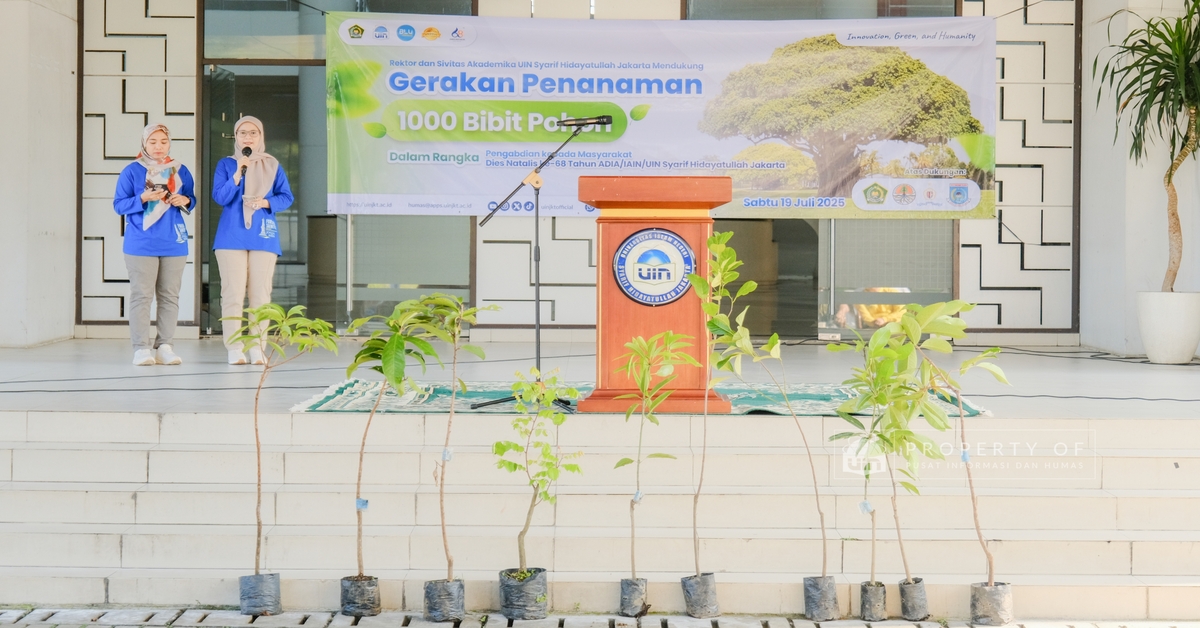
Water-conscious landscaping operates alongside the University's broader commitment to maintaining and expanding campus vegetation. In July 2025, Syarif Hidayatullah State Islamic University Jakarta organised a programme to plant 1,000 trees at its PPG Campus.
The initiative was part of the University's Green Campus vision and supported the Ministry of Religious Affairs' ecotheology programme. Campus vegetation provides ecological benefits including shade, improved environmental quality, soil protection, and increased water infiltration.
The University's Green Campus work programme also identifies tree planting and distribution of seedlings to community-service areas as environmental priorities. These activities demonstrate continued institutional investment in vegetated spaces.
The available documentation, however, does not establish that all tree species were specifically selected on the basis of drought tolerance.
5. Supporting Faculty-Level Green Landscaping
Academic units have also contributed to campus greening. In March 2025, the Faculty of Dirasat Islamiyah initiated the cultivation of Lee Kuan Yew plants around its faculty building. The programme aimed to expand green space, improve environmental quality, and support the University's Green Campus objectives.
Faculty-level planting programmes complement broader University landscaping initiatives and demonstrate engagement with environmental management across institutional units.
Water-conscious management of these planted areas can be further supported through efficient irrigation and water-reuse systems.
6. Supporting Planting through Water-Reuse Infrastructure
The University's wider water-management programme provides infrastructure relevant to sustainable planting.
Rainwater harvesting, infiltration systems, wastewater reuse, and conservation measures help reduce pressure on conventional freshwater resources. Reused water can support non-potable activities including landscape irrigation. This integrated approach allows planting and green-space development to be connected with broader water-efficiency objectives.
Rather than treating landscaping and water management as separate issues, Syarif Hidayatullah State Islamic University Jakarta increasingly links vegetation management with water conservation.
7. Institutional Support through Green Campus Policy
Water-conscious planting is supported by the University's broader Green Campus governance framework. Rector's Decree Number 1415 of 2024 establishes the University's Green Campus Policy. Rector's Circular Letter Number 22 of 2024 provides further guidance concerning water management.
These policies support conservation, reuse, environmental infrastructure, and responsible management of water resources across University operations.
The policy framework provides an institutional basis for expanding efficient irrigation and sustainable landscape practices.
8. Strengthening Water-Conscious Landscape Management
The University's existing practices demonstrate several complementary approaches to reducing water requirements for planting.
Sensor-based systems allow irrigation to respond more precisely to plant conditions. Reused ablution water provides an alternative irrigation source. Campus vegetation programmes expand ecological green space.
Water-management infrastructure supports conservation and groundwater recharge. Further documentation of plant-species selection, irrigation schedules, drought-tolerant vegetation, and quantitative irrigation-water savings would strengthen the University's monitoring of water-conscious landscaping.
9. Contribution to SDG 6: Clean Water and Sanitation
Syarif Hidayatullah State Islamic University Jakarta demonstrates a commitment to water-conscious planting through water-efficient irrigation technologies, water reuse, and sustainable landscape development. The University's Smart Urban Farming innovation uses soil-moisture sensors and automatic irrigation to provide water according to plant conditions and was explicitly designed to improve water efficiency.
The University also reuses filtered ablution water for automated landscape irrigation, reducing reliance on groundwater. These practices are complemented by tree-planting programmes, faculty-level greening initiatives, and institutional water-management policies.
Together, these measures demonstrate that Syarif Hidayatullah State Islamic University Jakarta integrates water conservation into planting and landscape management through efficient irrigation and the reuse of water resources. Through these initiatives, the University contributes to Sustainable Development Goal 6, particularly Indicator 6.3.5, by reducing unnecessary freshwater consumption in planting and supporting more sustainable landscape-management practices.


Source :
https://uinjkt.ac.id/id/inovasi-mahasiswa-uin-jakarta-smart-urban-farming-untuk-masa-depan-pertanian-perkotaan
https://www.uinjkt.ac.id/index.php/en/promoting-conscious-water-usage-on-campus-actively-promote-conscious-water-usage-on-campus-
https://www.uinjkt.ac.id/id/gerakan-penanaman-1000-bibit-pohon
https://www.fdi.uinjkt.ac.id/id/fdi-hijaukan-kampus-dengan-tanaman-lee-kuan-yew
https://biroauk.uinjkt.ac.id/id/dokumen