
UIN Jakarta Joins National Effort to Advance Indonesia’s Essential Oil Industry Through Research and Innovation
South Tangerang, UIN Jakarta Online News – Strengthening Indonesia's essential oil industry requires closer collaboration among universities, government institutions, research organizations, and industry players. With the country's rich biodiversity and growing global market demand, investment in research, technological innovation, and downstream development is essential to moving beyond raw material exports toward higher-value products.
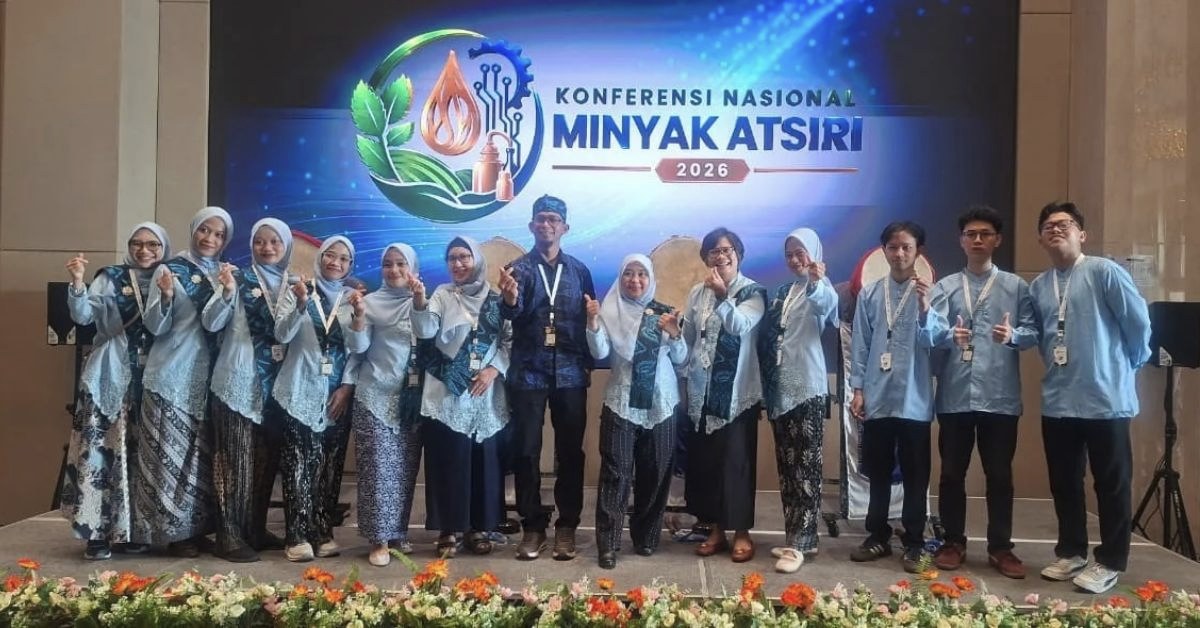
This was among the key issues addressed at the 2026 National Essential Oil Conference (Konferensi Nasional Minyak Atsiri/KNMA), in which UIN Syarif Hidayatullah Jakarta participated as a co-host. Through its Pharmacy Study Program at the Faculty of Health Sciences (FIKES), UIN Jakarta contributed to the conference, held on November 2–4, 2026, at Hotel Trembesi BSD, South Tangerang.
Under the theme Technological Innovation in Cultivation and Production Processes to Support the Sustainability and Competitiveness of Indonesia's Essential Oil Industry, KNMA 2026 brought together government representatives, academics, researchers, industry associations, and business practitioners to examine opportunities, challenges, and future directions for the country's essential oil sector.
Indonesia's rich diversity of essential oil-producing plants provides a strong foundation for developing a natural resource-based industry. The Ministry of Agriculture estimates that approximately 40 of the world's 99 known essential oil-producing plant species grow in Indonesia. These include patchouli, clove, citronella, nutmeg, vetiver, eucalyptus, agarwood, ginger, and ylang-ylang.
Essential oils are aromatic compounds extracted from various parts of plants through distillation or extraction processes. Their applications span a wide range of industries, including perfumery, cosmetics, food and beverages, aromatherapy, and pharmaceuticals.
The industry's economic potential is also reflected in Indonesia's export performance. Statistics Indonesia (BPS), as cited by the Ministry of Industry, recorded essential oil exports worth US$348.7 million in 2025, an increase of approximately 34.4 percent from US$259.5 million in 2024. This performance placed Indonesia among the world's five largest essential oil exporters.
One of the country's leading commodities is patchouli oil. In 2025, exports of Indonesian patchouli oil reached US$173.4 million, representing a 22.7 percent increase from the previous year. Its international markets include India, Singapore, France, Spain, the United States, China, Switzerland, Belgium, the Netherlands, Germany, the United Kingdom, and Türkiye.
Despite this growth, stronger export performance needs to be matched by greater domestic processing capacity. The Ministry of Industry has identified opportunities to develop higher-value downstream products, including high-grade patchouli oil, fragrances, antiseptics, medicated oils, and aromatherapy products. Improving supply chains, raw material quality, the capabilities of farmers and distillers, and partnerships with industry are equally important to building a competitive national essential oil ecosystem.
One of the sector's major challenges lies in processing technology. Some Indonesian essential oils are still exported in crude form, while refined derivatives are subsequently imported to meet the needs of the domestic cosmetics and pharmaceutical industries.
To address this gap, the National Research and Innovation Agency (BRIN), through its Molecular Chemistry Research Center, has been developing purification technologies to produce high-quality essential oil ingredients that meet industrial standards. These include vacuum fractional distillation, supercritical CO₂ extraction, molecular distillation, and ultrasonic-based technologies.
One notable development involves refining citronella oil to produce citronellal with a purity level exceeding 90 percent. The compound can then be further processed into isopulegol, a derivative with higher added value. BRIN has also developed formulations for various essential oil-based products, including solid perfumes, facial masks, lotions, and hand sanitizers.
BRIN researcher Egi Agustian explained that processing crude essential oils into highly purified ingredients for the cosmetics industry could increase their economic value by as much as tenfold. He emphasized that adopting advanced purification technologies and developing downstream products are crucial to strengthening the competitiveness of Indonesia's essential oil industry.
BRIN has also established research collaborations with several universities, including IPB University, the University of Indonesia, UIN Syarif Hidayatullah Jakarta, and Universitas Brawijaya. UIN Jakarta's involvement in this research network creates opportunities for academics to contribute to technological development, product formulation, and the wider industrial applications of natural resources.
During the KNMA 2026 program, UIN Jakarta Vice Rector for Cooperation and Institutional Development Din Wahid, M.A., Ph.D., expressed his appreciation to the Indonesian Essential Oil Council (Dewan Atsiri Indonesia/DAI) for involving the university as a co-host.
He highlighted the opportunities for interdisciplinary collaboration within UIN Jakarta, particularly involving the Pharmacy and Agribusiness Study Programs, alongside other academic disciplines. Such collaboration, he noted, could foster research, innovation, and downstream development across the essential oil value chain, from natural resource utilization to the creation of value-added products for communities and industry.
The conference's main agenda took place on Tuesday (November 3, 2026), featuring its opening by Mochamad Hardi, S.T., M.M., Head of the South Tangerang City Industry Office, who also inaugurated the Indonesian Essential Oil Council's 2026–2031 executive board. The event also featured Deputy Minister of Industry Faisol Riza as the keynote speaker.
In his address, Faisol Riza called for stronger downstream development to ensure that Indonesia moves beyond its role as a raw material supplier and becomes a producer of higher-value essential oil products, particularly for the fragrance, cosmetics, and pharmaceutical industries.
KNMA 2026 attracted approximately 190 participants and received support from 36 sponsors representing various sectors. Discussions covered cultivation technologies, production processes, marketing, biological activities, downstream product development, sustainability, and biodiversity.
UIN Jakarta's involvement extended beyond institutional representation. Through the Pharmacy Study Program at FIKES, the university deployed two lecturers, apt. Hendri Aldrat, M.Si., and apt. Adha Dastu Illahi, M.Farm., alongside 17 students who joined the organizing committee.
The students contributed to various aspects of the event, including participant registration, serving as masters of ceremonies, providing technical and operational support, and performing a traditional dance presented by FIKES students.
Their participation also provided valuable practical experience in organizing a national-scale event, developing communication and teamwork skills, and establishing networks with academics, researchers, government representatives, and industry practitioners.
The conference concluded on Wednesday (November 4, 2026), with field visits to the National Research and Innovation Agency (BRIN) and Paragon. These visits gave participants an opportunity to observe how research and technological development are translated into practical applications within the industrial sector.
Through its participation in KNMA 2026 and its broader research partnerships, UIN Jakarta continues to strengthen the role of higher education in connecting scientific advancement with the needs of society and industry. By expanding interdisciplinary collaboration, research initiatives, and industry partnerships, the university aims to contribute to the sustainable utilization of Indonesia's biodiversity, the creation of greater economic value from domestic commodities, and the stronger global competitiveness of Indonesian essential oil products.