Strengthening Government Cooperation for Water Security and Environmental Resilience at Syarif Hidayatullah State Islamic University Jakarta
Syarif Hidayatullah State Islamic University Jakarta contributes to water security through collaboration with national government institutions, environmental research, community-based conservation initiatives, and institutional water-management programmes.
The University recognises that water security requires more than efficient water use within campus boundaries. It also depends on cooperation among government institutions, universities, communities, and other stakeholders to protect water resources, reduce pollution, strengthen conservation practices, and improve environmental resilience.
During 2024–2025, Syarif Hidayatullah State Islamic University Jakarta strengthened this collaborative approach through the Religious Environmentalism Actions (REACT) programme, engagement with national government institutions, research concerning community-based water conservation, and environmental activities involving local public stakeholders. These initiatives contribute to Sustainable Development Goal 6: Clean Water and Sanitation, particularly Indicator 6.5.4 concerning cooperation with government institutions on water security.
1. Building National Government Cooperation through the REACT Programme
On 25 April 2024, the Center for the Study of Islam and Society (PPIM) at Syarif Hidayatullah State Islamic University Jakarta convened a Project Board Meeting under the Religious Environmentalism Actions programme. The meeting brought together representatives from major national government institutions, including the Ministry of Environment and Forestry, Ministry of Religious Affairs, Ministry of Education, Culture, Research and Technology, and the National Research and Innovation Agency.
The forum was designed to identify challenges and opportunities for strengthening community responses to environmental degradation and climate change. Researchers and government representatives exchanged knowledge concerning environmental behaviour, community resilience, environmental education, and policy development.
This engagement established a structured mechanism connecting University research with national public institutions responsible for environmental and sustainability policy.
2. Strengthening Cooperation with the Ministry of Environment and Forestry
Government engagement under REACT was supported by direct communication with the Ministry of Environment and Forestry.
On 4 March 2024, PPIM Syarif Hidayatullah State Islamic University Jakarta held discussions with Ministry representatives at Manggala Wanabakti in Jakarta. The meeting explored opportunities to strengthen cooperation concerning religion, environmental protection, climate action, and community behaviour.
The Ministry welcomed the REACT programme and highlighted the importance of engaging younger generations in environmentally responsible behaviour. This engagement demonstrates direct interaction between the University and the national institution responsible for environmental governance.
3. Integrating Water Conservation into Community Environmental Research
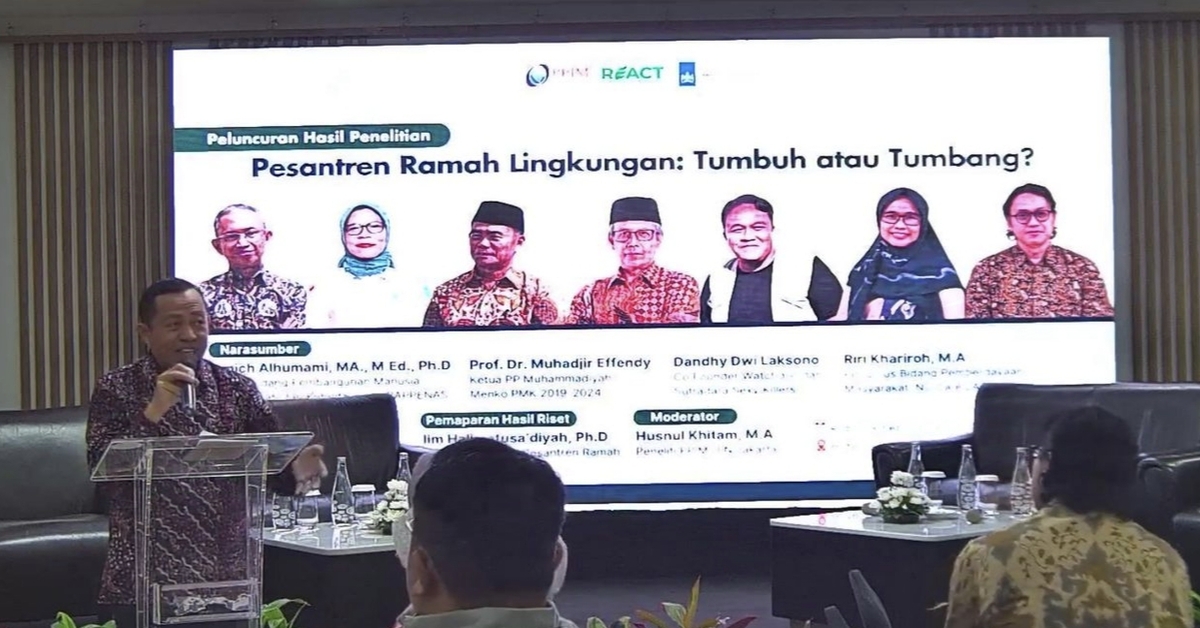
The REACT programme subsequently produced research examining environmentally responsible practices within Islamic boarding schools and Muslim communities. The research documented several forms of environmental innovation, including waste management, sustainable land use, gardening, environmental education, and water conservation.
Water conservation was identified as one of the practical sustainability measures adopted by participating institutions. This research provides an important connection between broader environmental cooperation and water security.
By documenting existing water-conservation practices, identifying implementation challenges, and communicating the results to government stakeholders, Syarif Hidayatullah State Islamic University Jakarta contributes evidence that can support more sustainable environmental policy.
4. Connecting Research Findings with Public Policy
PPIM's policy-engagement model is designed to ensure that research findings are communicated beyond the academic community. Research outputs are shared through Project Board Meetings, policy discussions, public dissemination, stakeholder engagement, and policy recommendations.
Government representatives therefore participate not only as observers but also as stakeholders who can respond to research findings and contribute perspectives concerning implementation.
This approach helps connect community-level environmental practices, including water conservation, with national environmental policymaking. Such collaboration contributes to water security by improving understanding of how communities conserve water, respond to environmental pressures, and manage natural resources.
5. Supporting Local Environmental Cooperation around Situ Gintung
Syarif Hidayatullah State Islamic University Jakarta students also participated in environmental collaboration in the Situ Gintung area of South Tangerang during September 2024.
Working through the Karya Salemba Empat scholarship community, participants collaborated with the Gintung Dam management, local communities, and related government agencies.
Planting activities were conducted at the Situ Gintung Monument, Situ Center, and Gintung Dam Guard House.
The programme involved coordination with public stakeholders concerning tree provision and sustainable planting locations.
Although the documented activity primarily emphasised environmental greening and air-quality improvement, cooperation around an important local water body demonstrates the University's capacity to work with local public stakeholders in environmental stewardship.

6. Supporting Cooperation through University Water Policy
External collaboration is complemented by the University's own water-management framework.
Rector's Circular Letter Number 22 of 2024 establishes institutional guidance concerning water management.
The framework includes water conservation, rainwater management, infiltration facilities, water reuse, and protection of water resources.
Rector's Circular Letter Number 18 of 2024 further addresses wastewater treatment and pollution prevention.
These policies strengthen the University's institutional capacity to participate credibly in wider discussions and partnerships concerning water conservation and environmental sustainability.
7. Linking Water Security with Climate and Environmental Resilience
Water security is closely connected with climate change, pollution, ecosystem protection, and community resilience. The University's environmental cooperation therefore addresses several interconnected dimensions.
Government engagement supports policy dialogue. Research identifies community practices in water conservation. University water policies improve institutional resource management. Community programmes strengthen public participation in environmental stewardship.
Together, these mechanisms contribute to a wider approach to protecting water resources and strengthening environmental resilience.
8. Strengthening Future Government Cooperation on Water Security
The available evidence demonstrates that Syarif Hidayatullah State Islamic University Jakarta cooperates with national government institutions on environmental sustainability and conducts research addressing water conservation. Further development of dedicated water-security partnerships would strengthen this contribution.
Potential areas include groundwater protection, watershed management, urban water resilience, drinking-water access, flood risk, water-quality monitoring, and community-based conservation.
Formal agreements with local water authorities, environmental departments, river-basin organisations, or national ministries explicitly identifying water security would provide stronger evidence of institutional cooperation.
9. Contribution to SDG 6: Clean Water and Sanitation
Syarif Hidayatullah State Islamic University Jakarta demonstrates an institutional foundation for government cooperation relevant to water security.
Through the REACT programme, the University engages national government institutions including the Ministry of Environment and Forestry, Ministry of Religious Affairs, Ministry of Education, Culture, Research and Technology, and the National Research and Innovation Agency. Research conducted through the programme has documented water-conservation practices among communities and Islamic educational institutions.
Syarif Hidayatullah State Islamic University Jakarta has also participated in environmental collaboration with public stakeholders around the Situ Gintung area and maintains institutional policies addressing water conservation, wastewater management, and pollution prevention.
Together, these initiatives demonstrate cooperation between Syarif Hidayatullah State Islamic University Jakarta, government institutions, researchers, and communities on environmental issues that include water conservation and sustainable resource management.
These activities support Sustainable Development Goal 6, particularly Indicator 6.5.4, while more explicit government agreements specifically addressing water security would further strengthen the University's evidence.
Source :
https://ppimcensis.or.id/2024/04/26/dorong-kolaborasi-hadapi-krisis-iklim-dan-lingkungan-ppim-uin-jakarta-gelar-project-board-meeting-program-religious-environmentalism-actions-react/
https://ppimcensis.or.id/2024/03/06/ppim-uin-jakarta-diskusi-agama-dan-perubahan-iklim-di-manggala-wanabakti/
https://uinjkt.ac.id/en/promoting-green-islam-ppim-uin-jakarta-reveals-its-latest-research-on-eco-friendly-islamic-boarding-school
https://www.uinjkt.ac.id/id/uin-jakarta-dan-karya-salemba-empat-gelar-tanam-4000-pohon-di-40-titik-se-nusantara
https://biroauk.uinjkt.ac.id/id/dokumen