
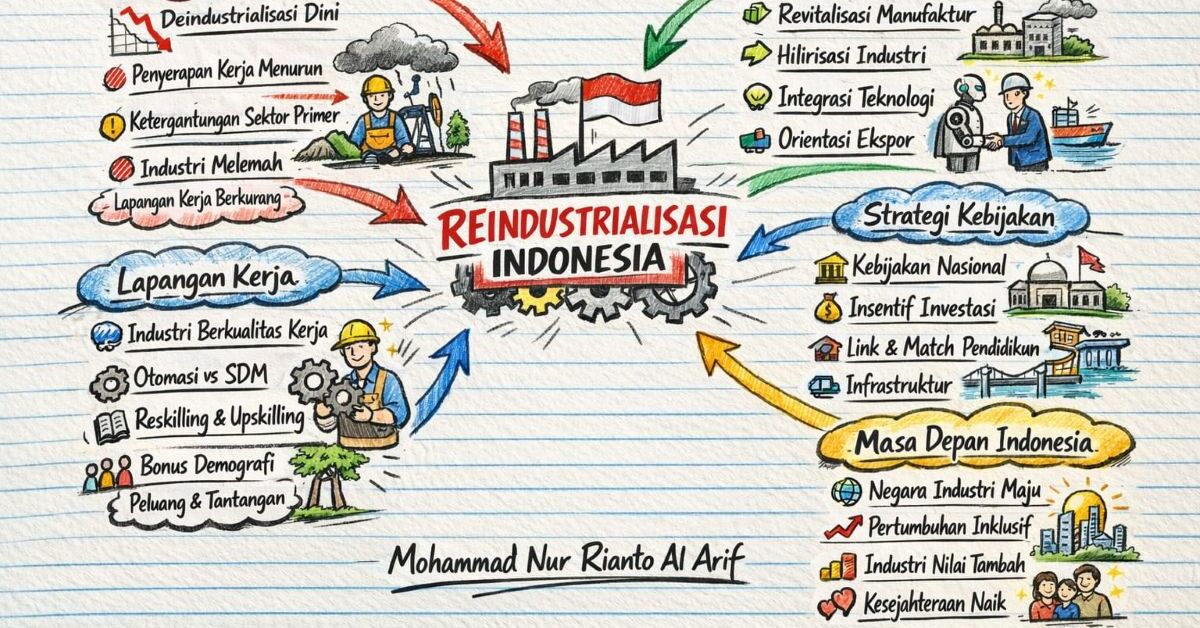
Reindustrialization: Indonesia’s Key to Quality Job Creation
Mohammad Nur Rianto Al Arif
(Professor at UIN Syarif Hidayatullah; Secretary General of DPP Indonesian Lecturers Association; Board Member of DPP IAEI; Board Member of ISEI Jakarta Chapter)
Indonesia is currently standing at a crucial point in its economic journey. On one hand, economic growth remains relatively stable. Statistics Indonesia (BPS) recorded that Indonesia’s economy grew by 5.11 percent throughout 2025.
However, on the other hand, the structural foundation of the economy still leaves fundamental issues, especially related to the quality of growth and labor absorption.
Stable economic growth does not necessarily guarantee the creation of sufficient jobs.
This is where the urgency of reindustrialization becomes increasingly clear. The history of global economic development shows that no country has successfully become developed without being supported by a strong industrial sector.
In recent years, Indonesia’s manufacturing sector has shown signs of recovery.
BPS data shows that in the fourth quarter of 2025, the manufacturing sector contributed around 19.20 percent to GDP, making it the largest contributor to the national economy.
Annually, this contribution stood at around 19.07 percent in 2025, with sector growth reaching about 5.3 percent.
However, these figures need to be read critically. Although it has returned as the largest contributor, Indonesia’s manufacturing share is still far from its peak in the early 2000s, when it nearly reached 30 percent.
This means the process of premature deindustrialization that once occurred has not been fully recovered.
In fact, during several periods in 2025, manufacturing’s contribution dropped to around 17.39 percent. This fluctuation shows that Indonesia’s industrial structure is still fragile and highly influenced by global and domestic demand dynamics.
The most crucial issue in Indonesia’s economic structure lies in the labor market.
As of August 2025, the open unemployment rate stood at 4.85 percent, or around 7.46 million people.
At a glance, this figure looks improved compared to the previous year. However, the deeper issue lies in the quality of available jobs.
The proportion of formal workers has indeed increased but remains limited at around 42.20 percent, meaning the majority of Indonesia’s workforce is still in the informal sector.
This data shows that economic growth has not fully translated into decent and sustainable jobs.
From a sectoral perspective, the manufacturing industry only absorbs about 13.86 percent of the national workforce, far below the agricultural sector, which reaches over 28 percent.
In theory, the manufacturing sector should be the main engine of productive job creation.
This is where Indonesia’s economic paradox becomes clear: high-productivity sectors (manufacturing) are not the main job absorbers, while low-productivity sectors (informal and traditional agriculture) dominate.
Expectations for reindustrialization are also reflected in investment trends.
Throughout 2025, investment in the manufacturing sector reached hundreds of trillions of rupiah, with new job absorption of around 300,000 workers in the first half of 2025.
In 2026, the government even targets new industrial investment to absorb around 218,000 additional workers.
However, these numbers must be seen in a broader context.
Every year, Indonesia faces an addition of around 2–3 million new entrants to the labor force.
This means the industrial sector’s capacity to absorb labor is still insufficient to keep up with workforce growth.
In other words, without more aggressive reindustrialization acceleration, the gap between job creation and labor force growth will continue to widen.
One of the new challenges in reindustrialization is the emerging dilemma between productivity and labor absorption.
With the adoption of technology and automation, industries are becoming more efficient, but not necessarily requiring more workers.
This phenomenon is already visible in Indonesia, where increased industrial output is not always followed by significant increases in employment.
Some studies even show an “anomaly” in the manufacturing sector, where efficiency gains are accompanied by reduced labor demand.
This means that reindustrialization in the modern era can no longer rely solely on traditional labor-intensive industries. A balance is needed between labor-intensive and technology-intensive industries.
Amid these challenges, there are also indicators of positive momentum.
Indonesia’s manufacturing PMI, for example, is in expansion territory (above 50), reaching 51.2 in October 2025, signaling increased industrial activity.
In addition, manufacturing growth of around 5.4 percent in 2025—the highest in the past decade—shows that this sector still holds strong potential as a growth engine.
However, this momentum must be used strategically. Without the right policies, the recovery may be temporary and unsustainable.
In a broader framework, reindustrialization must be positioned as a key strategy for creating quality jobs.
Several approaches can be taken.
First, strengthening modern labor-intensive industries. Sectors such as textiles, footwear, and furniture still have high employment absorption but need to move up the value chain through technology and market access.
Second, promoting downstream processing of resource-based industries. This policy not only increases value added but also creates longer industrial chains and absorbs more labor.
Third, developing high-tech industries. Although not labor-intensive, this sector is important for increasing competitiveness and creating high-quality jobs.
Fourth, strengthening linkages between large industries and MSMEs. Without this integration, the benefits of industrialization will not be widely distributed.
Although the direction of reindustrialization policy is becoming clearer, there are several critical notes.
First, industrial policies are still sectoral and not fully integrated.
Second, excessive focus on commodity downstreaming risks neglecting the development of technology-based manufacturing industries.
Third, labor and education reforms have not progressed as fast as industrial needs.
In addition, economic concentration in Java—which accounts for around 56.93 percent of total national GDP—shows that industrialization has not been evenly distributed geographically.
Indonesia does not lack potential. With a large population, abundant natural resources, and a strategic position in the global supply chain, the opportunity to become an advanced industrial nation is wide open.
However, potential without strategy will remain an illusion.
Reindustrialization is not just a policy choice but a historical necessity. Without it, Indonesia risks being trapped in stagnant economic growth, with inadequate job creation and widening inequality.
On the other hand, with the right reindustrialization—data-driven, inclusive, and future-oriented—Indonesia can not only strengthen its economic structure but also ensure that growth is truly felt by all segments of society.
In the end, the true measure of economic success is not just how high growth is but how many lives are improved through decent work. And at that point, reindustrialization finds its true meaning.
This article was published in Kompas on Monday, March 23, 2026.