Empowering Local Communities through Sustainable Development Education and Outreach at Syarif Hidayatullah State Islamic University Jakarta
Syarif Hidayatullah State Islamic University Jakarta is committed to extending education for sustainable development beyond its academic community through practical training, community engagement, and partnerships with local organisations. The University recognises that achieving the Sustainable Development Goals (SDGs) requires wider public participation and that educational institutions have an important responsibility to share knowledge, build community capacity, and support sustainable practices beyond campus boundaries.
Through its SDGs Center, academic faculties, community service programmes, student organisations, and external partnerships, Syarif Hidayatullah State Islamic University Jakarta provides educational activities that address environmental sustainability, responsible consumption, financial literacy, and community empowerment.
During 2024–2025, these commitments were demonstrated through community-based ecoenzyme training, waste-management education, financial-literacy programmes, and collaborative outreach initiatives. These activities contribute to SDG 17: Partnerships for the Goals, particularly Indicator 17.4.3 concerning education for the SDGs in the wider community.
1. Delivering Sustainable Waste Management Education to Local Communities

During July and August 2024, students from the Agribusiness Study Programme, through the GENTA student community, collaborated with the SDGs Center of Syarif Hidayatullah State Islamic University Jakarta to conduct ecoenzyme education and training activities. The programmes were implemented in nine villages in Tangerang Regency and two urban villages in South Tangerang.
The activities were designed to help local communities understand and apply practical household waste-management techniques. Participants learned how organic household waste, including fruit peels and vegetable residues, could be processed into ecoenzyme products.
The programme encouraged communities to reduce waste disposal and open burning while exploring more sustainable ways to manage organic materials. The educational activities targeted household members, local officials, community leaders, and young people. By involving a wide range of local stakeholders, the programme sought to extend environmental knowledge beyond individual participants and encourage the dissemination of sustainable practices within local communities.
2. Integrating SDGs Education with Community Service
The 2024 ecoenzyme education programme was implemented through community service activities associated with the University's Community Service Programme (Kuliah Kerja Nyata, KKN). This approach connects academic expertise with practical challenges encountered by local residents.
The programme was supported by lecturers from the Faculty of Science and Technology and coordinated with the University's SDGs Center. Through these arrangements, students and academic staff contributed knowledge relevant to household waste reduction, responsible consumption, and environmental awareness.
The initiative demonstrated how universities can translate sustainability-related knowledge into accessible educational activities for wider society. Its relevance extends to several Sustainable Development Goals, particularly SDG 4: Quality Education, SDG 11: Sustainable Cities and Communities, SDG 12: Responsible Consumption and Production, and SDG 17: Partnerships for the Goals.
3. Providing Financial Literacy and Waste Management Education for Schoolchildren

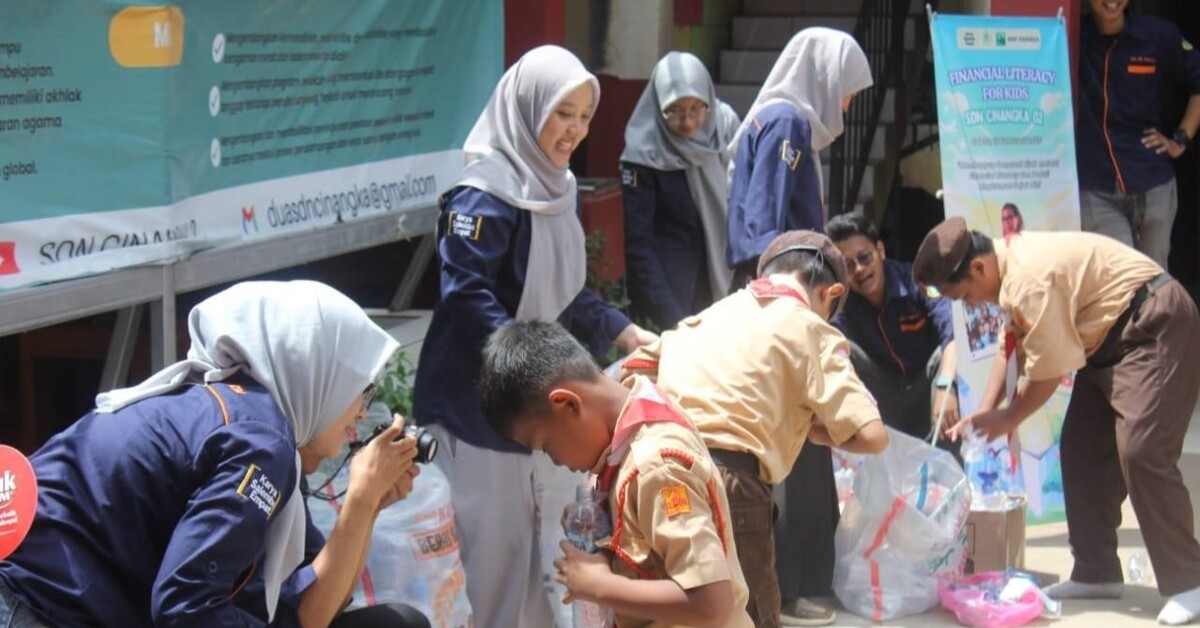
On 15 February 2025, Syarif Hidayatullah State Islamic University Jakarta students receiving scholarships through the Karya Salemba Empat Foundation collaborated with PT Bank BNP Paribas Indonesia to organise an educational programme entitled Bank Sampah SD & Financial Literacy for Kids. The activity was conducted at SDN 02 Cinangka, Depok, and involved 100 schoolchildren, 16 teachers, and 20 Syarif Hidayatullah State Islamic University Jakarta scholarship recipients.
The programme was designed to strengthen students' understanding of waste management and basic financial planning. Educational sessions introduced waste separation, waste-bank practices, and the relationship between responsible waste management and economic value.
The programme also incorporated practical activities involving the collection, weighing, and sorting of recyclable materials. Through these activities, schoolchildren were encouraged to develop environmentally responsible habits and basic financial-literacy skills. This initiative demonstrates how Syarif Hidayatullah State Islamic University Jakarta extends sustainability-related education to younger members of the wider community through collaboration with external partners.
4. Continuing Ecoenzyme Training in 2025

Syarif Hidayatullah State Islamic University Jakarta continued delivering community-oriented sustainability education during 2025. On 15 August 2025, the Faculty of Science and Technology reported collaborative ecoenzyme training activities involving lecturers, students, and the University's SDGs Center.
The programmes were implemented in Badak Anom Village, Tangerang Regency, and Durian Mekar, Depok. In Badak Anom, the training formed part of the activities of Community Service Group 187 Vidyakara. The activities provided practical guidance on processing household organic waste into ecoenzyme products as an environmentally oriented approach to waste management.
Similar educational activities were conducted through Community Service Group 29 Nawa Karsa in Durian Mekar, with students from Agribusiness, Biology, and Mining Engineering contributing to the programme. These initiatives encouraged local residents to explore waste-reduction practices and apply accessible environmental-management techniques within their communities. The continued implementation of ecoenzyme education across 2024 and 2025 demonstrates a sustained commitment to community-based sustainability learning.
5. Building Partnerships for Environmental Education
Syarif Hidayatullah State Islamic University Jakarta's community education initiatives involve cooperation between academic units, student organisations, local communities, schools, and external institutions. The SDGs Center works with academic departments to support practical education related to sustainable development. Student-led initiatives also create opportunities for community participation, particularly through KKN activities.
The financial-literacy and waste-management programme at SDN 02 Cinangka illustrates collaboration between students, a scholarship organisation, and a private-sector partner. Such partnerships allow the University to connect academic knowledge with practical educational needs and to engage participants who may not otherwise have access to university-based sustainability programmes. This approach supports the central principle of SDG 17: achieving sustainable development through collaboration and shared responsibility.
6. Supporting Education on Human Rights and Refugee Protection

In addition to environmental education, Syarif Hidayatullah State Islamic University Jakarta has promoted awareness of humanitarian issues and the rights of displaced populations. On 12 June 2025, the International Relations Study Programme within the Faculty of Social and Political Sciences organised a public lecture addressing the role of civil society organisations in global refugee protection. The programme involved speakers from Universitas Gadjah Mada, SUAKA, and Jesuit Refugee Service Jakarta.
Discussions covered international refugee protection, human-rights principles, access to public services, and the role of civil society in humanitarian solidarity. The activity contributed to awareness of inequality and displacement-related challenges and encouraged greater understanding of the role of communities and institutions in protecting vulnerable populations.
Although the lecture addressed issues affecting refugees, the available documentation does not establish that refugees themselves participated as recipients of educational outreach. It is therefore best understood as supporting evidence of broader sustainability and human-rights education.
7. Strengthening Community Participation and Practical Learning
Syarif Hidayatullah State Islamic University Jakarta's educational outreach programmes are designed to promote practical knowledge relevant to everyday community challenges. Ecoenzyme training introduces methods for managing household organic waste.
Waste-bank education encourages participants to recognise the environmental and economic value of recyclable materials. Financial-literacy activities help younger participants develop basic money-management awareness. Community service activities also create opportunities for students and lecturers to work directly with residents and share knowledge in accessible forms.
These initiatives demonstrate that education for sustainable development can take place through practical community activities rather than being limited to classroom-based instruction. Through collaborative educational programmes, Syarif Hidayatullah State Islamic University Jakarta contributes to developing the knowledge and capacity of local communities.
8. Strengthening Monitoring and Evaluation of Community Education
Community outreach activities are important components of the University's commitment to sustainable development. The available documentation establishes the implementation of several educational programmes involving local residents, schoolchildren, teachers, and community stakeholders.
Further improvements could include systematic recording of participant numbers, attendance by beneficiary group, learning materials, and evaluations of knowledge gained. Documentation distinguishing alumni participants, local residents, displaced populations, and other beneficiary groups would also support more precise reporting.
Such information would strengthen the University's ability to evaluate the reach and effectiveness of its sustainability-related educational programmes.
9. Contribution to SDG 17: Partnerships for the Goals
Syarif Hidayatullah State Islamic University Jakarta demonstrates a continuing commitment to educating the wider community about sustainable development. During 2024, its SDGs Center and Agribusiness student community implemented ecoenzyme training across nine villages and two urban villages in Tangerang and South Tangerang.
In February 2025, Syarif Hidayatullah State Islamic University Jakarta scholarship recipients collaborated with PT Bank BNP Paribas Indonesia to deliver waste-bank and financial-literacy education involving 100 schoolchildren and 16 teachers. Additional ecoenzyme education activities were implemented in Badak Anom and Durian Mekar during August 2025. These programmes demonstrate collaboration between university students, academic staff, local communities, schools, and external partners.
Together, these documented initiatives confirm that Syarif Hidayatullah State Islamic University Jakarta provides dedicated sustainability-related educational outreach to local communities beyond the University, supporting practical knowledge, environmental responsibility, and community empowerment. Through these efforts, Syarif Hidayatullah State Islamic University Jakarta contributes to SDG 17, particularly Indicator 17.4.3, by strengthening partnerships and extending sustainable development education to the wider community.
Source :
https://uinjkt.ac.id/index.php/en/public-lecture-by-uin-jakartas-international-relations-program-highlights-global-refugee-protection-solidarity
https://fst.uinjkt.ac.id/index.php/en/sdgs-center-lecturers-and-students-of-fst-uin-jakarta-collaborate-to-hold-ecoenzyme-training-in-two-locations
https://www.uinjkt.ac.id/id/kse-uin-jakarta-bersama-pt-bank-paribas-indonesia-gelar-edukasi-finansial-bank-sampah-untuk-generasi-muda
https://fst.uinjkt.ac.id/index.php/id/sosialisasi-dan-pelatihan-ekoenzim-di-kabupaten-tangerang-dan-kota-tangerang-selatan-bersama-prodi-agribisnis-melalui-genta-dan-sdgs-center-uin-jakarta