AICIS+ 2026: Religious Affairs Minister Urges PTKIN to Rethink Islamic Education in the Digital Era
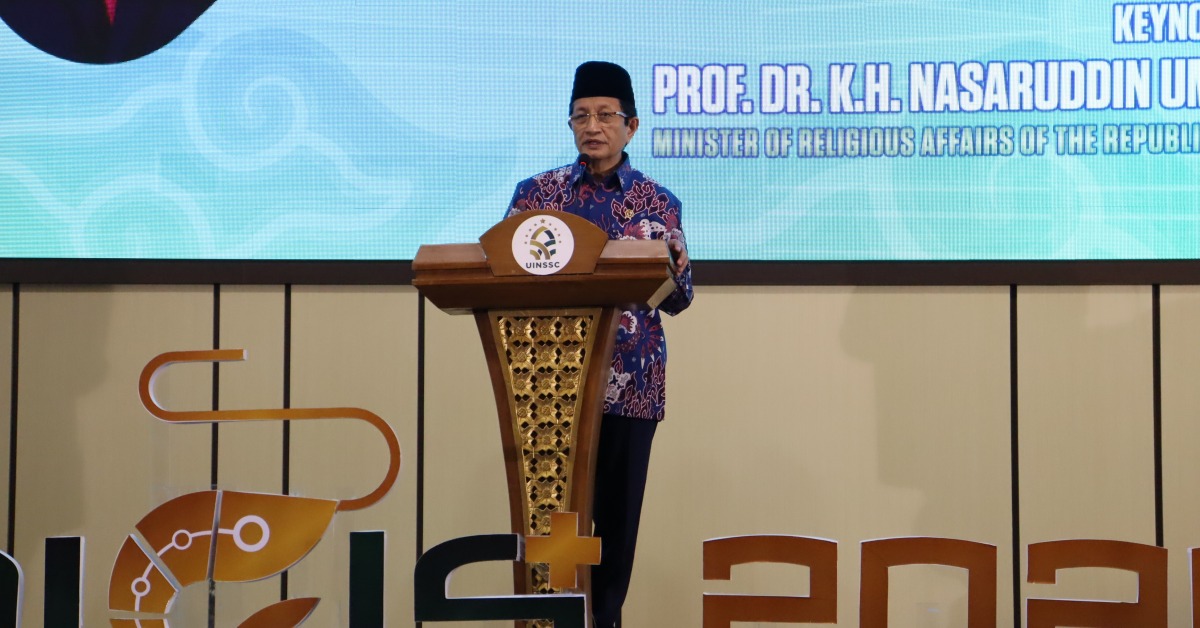
Cirebon, UIN News Online – The rapid rise of digital technology and artificial intelligence is reshaping how younger generations learn about and understand religion, prompting Indonesia’s Islamic higher education institutions to rethink their approaches to education. Religious Affairs Minister Nasaruddin Umar called on State Islamic Religious Universities (PTKIN) to transform their educational systems while preserving the fundamental principles of Islam.
He delivered the message on Tuesday, (11/17/2026), while officially opening the 25th Annual International Conference on Islam, Science, and Society (AICIS+) 2026 at UIN Siber Syekh Nurjati Cirebon.
Nasaruddin observed that religious knowledge is no longer acquired solely through family traditions, local communities, or conventional religious authorities. Young people increasingly explore religious perspectives independently through the internet, social media, and artificial intelligence, changing the way religious understanding develops.
He said this shift presents both challenges and opportunities for Islamic higher education institutions and pesantren, requiring them to adapt curricula and teaching methods to contemporary developments and workforce demands without compromising Islamic principles.
“PTKIN management must be able to respond to changing societal needs and the demands of the workplace. However, there are boundaries that must be maintained. Teaching methods and approaches can evolve with the times, while fundamental principles of sharia must remain our foundation,” he said.
AICIS+ 2026 carries the theme “Revitalizing Islamic Civilization for Sustainable Life: Local Heritage, Technological Innovation, and Human Flourishing.” The international conference brings together scholars and intellectuals from various countries to explore the contribution of Islamic scholarship to scientific advancement, technological innovation, and contemporary social challenges.
This year's conference attracted 3,420 abstracts from 607 institutions across 21 countries on five continents, marking a significant increase from the 2,434 abstracts submitted to AICIS 2025. The growing participation reflects expanding international academic interest in the intersection of Islam, science, and society.
Nasaruddin also stressed that innovations in Islamic economics and banking must remain grounded in fiqh muamalah (Islamic jurisprudence governing transactions). Technological and industrial progress, he said, should not come at the expense of Islamic scholarly identity or its underlying principles.
He further encouraged Muslim scholars to develop contextual approaches to Islamic jurisprudence by engaging with scientific and technological developments. Weather modification technologies such as cloud seeding, he noted, offer examples of emerging phenomena that warrant further scholarly examination.
The minister also called for greater interdisciplinary and interfaith collaboration, drawing inspiration from the intellectual tradition of Bayt al-Hikmah, the historic center of scholarship and translation during the Islamic Golden Age. He encouraged PTKIN to strengthen ecotheology in line with the Istiqlal Declaration, implement the Ministry of Religious Affairs’ Kurikulum Cinta (Curriculum of Love), and expand religious diplomacy in support of global peace.
His message underscored that Islamic higher education must do more than keep pace with technological change; it must help shape that change through scholarship, Islamic values, and meaningful contributions to humanity.
Separately, Rector of UIN Jakarta, Prof. Asep Saepudin Jahar, M.A., Ph.D., welcomed the minister’s call, emphasizing that digital transformation should not be limited to technological adoption. Rather, it should strengthen the relevance of Islamic higher education in addressing societal concerns and global humanitarian challenges.
“The Minister’s message serves as an important reminder for Islamic universities to continue developing an intellectual tradition that is open, integrative, and responsive to changing times. Technological competence, including artificial intelligence, must go hand in hand with ethical awareness, academic integrity, and Islamic values,” he said.
Asep also highlighted the importance of interdisciplinary collaboration in advancing knowledge within PTKIN. Dialogue among religious studies, science, technology, and social sciences, he said, is essential for Islamic universities to move beyond being centers of religious scholarship and become institutions capable of delivering practical solutions to societal challenges.
He expressed hope that AICIS+ 2026 would foster stronger international academic networks and generate innovative ideas that enhance the role of Islamic higher education in building a civilization that is inclusive, sustainable, and oriented toward the well-being of humanity.