University principles on corruption and bribery Publish the university's principles and commitments on organized crime, corruption & bribery
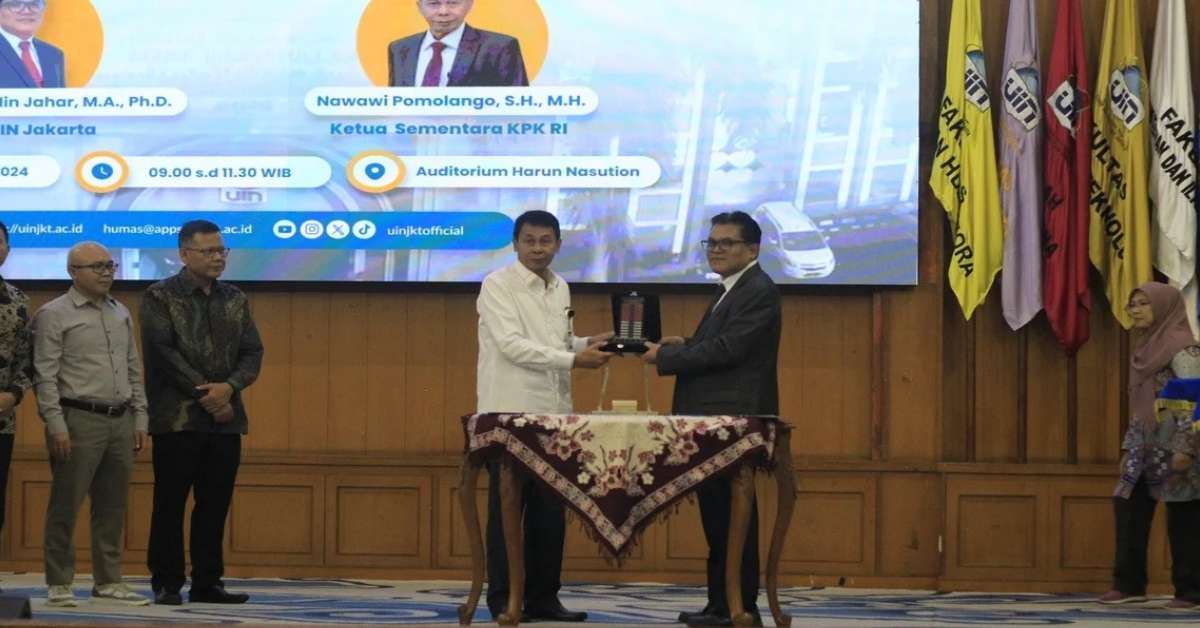
1. MoU between Syarif Hidayatullah State Islamic University and KPK RI on Anti-Corruption Awareness
Syarif Hidayatullah State Islamic University demonstrates its commitment to promoting integrity and preventing corruption through collaboration with the Corruption Eradication Commission of the Republic of Indonesia (KPK RI). On 14 May 2024, the university signed a Memorandum of Understanding (MoU) with KPK RI, accompanied by a public lecture entitled “Sinergi KPK RI dan Peran Lembaga Pendidikan dalam Pemberantasan Korupsi.” This initiative highlights the role of higher education institutions in building awareness of corruption prevention and encouraging transparent and accountable governance.
2. Integrity Zone Declaration Charter (Piagam Pencanangan Zona Integritas) awarded to the Faculty of Sharia and Law

Corruption, bribery and organized crime undermine justice, public trust and the quality of education. As a faculty that educates future jurists, judges, legal practitioners and Islamic legal scholars, the Faculty of Sharia and Law of UIN Syarif Hidayatullah Jakarta carries a particular responsibility to model integrity in its own governance. In line with SDG 16, which calls for effective, accountable and transparent institutions, the Faculty has committed to developing an Integrity Zone, a work unit that is free from corruption and that delivers clean, accountable and service-oriented administration.
The objectives of this program are: (1) to publicly state the Faculty's principles and commitments against corruption, bribery and organized crime; (2) to embed these principles in academic, administrative and financial processes; and (3) to strengthen oversight and accountability so that the commitments can be verified by internal and external parties.
3. Faculty-Public Discussion on Government Political Communication and Public Policy
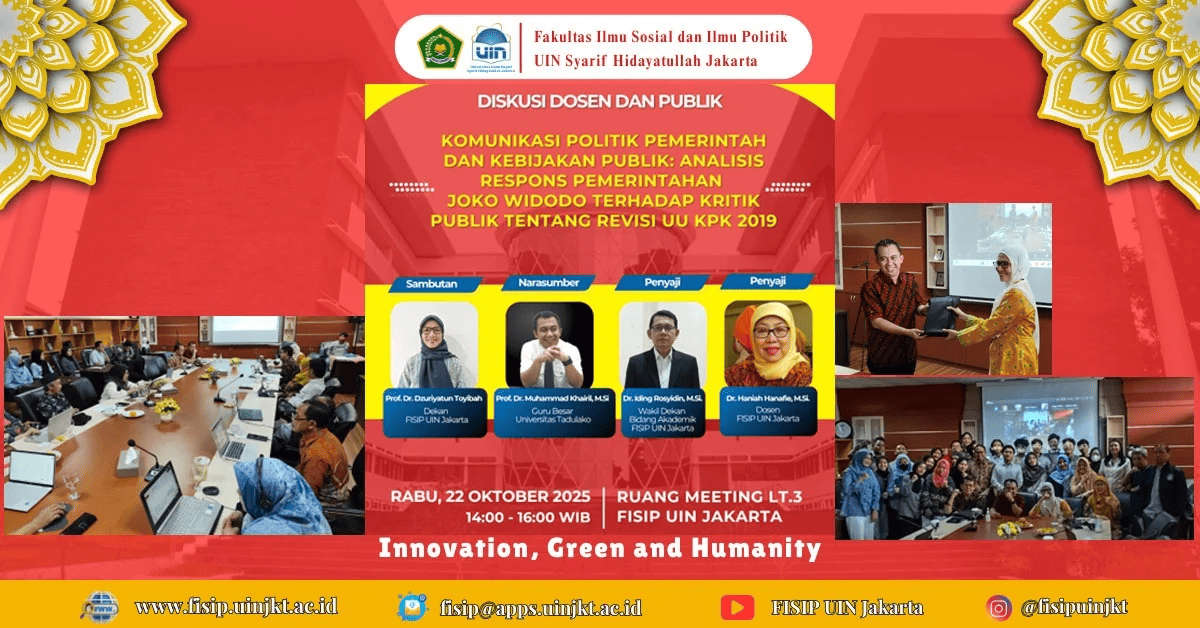
The Faculty of Social and Political Sciences (FISIP) at UIN Jakarta held a discussion event for faculty and the public on the theme “Government Political Communication and Public Policy: An Analysis of the Joko Widodo Administration’s Response to Public Criticism Regarding the 2029 Revision of the KPK Law.” The discussion was moderated by Dr. Iding Rosyidin, M.Si, and Dr. Haniah Hanafie, M.Si, and featured Prof. Dr. Muhammad Khairil, M.Si (Professor at Tadulako University) as a guest speaker.
The guest speaker also noted that the crux of the issue lies in the extremely rushed and suspicious nature of the KPK Law revision a process that, while public policy should involve public participation, instead appears to be merely a transaction between the government and the House of Representatives (DPR). In terms of communication, it is largely one-sided, with the government dictating terms and the public expected to accept them. “It is important to note which specific provisions of the KPK Law were revised provisions that weaken the KPK itself as well as those related to wiretapping and the reclassification of KPK staff as civil servants,” said Muhammad Khairil.