
UIN Jakarta Concludes International Short Course on Women Ulama, Gender Justice, and Social Transformation
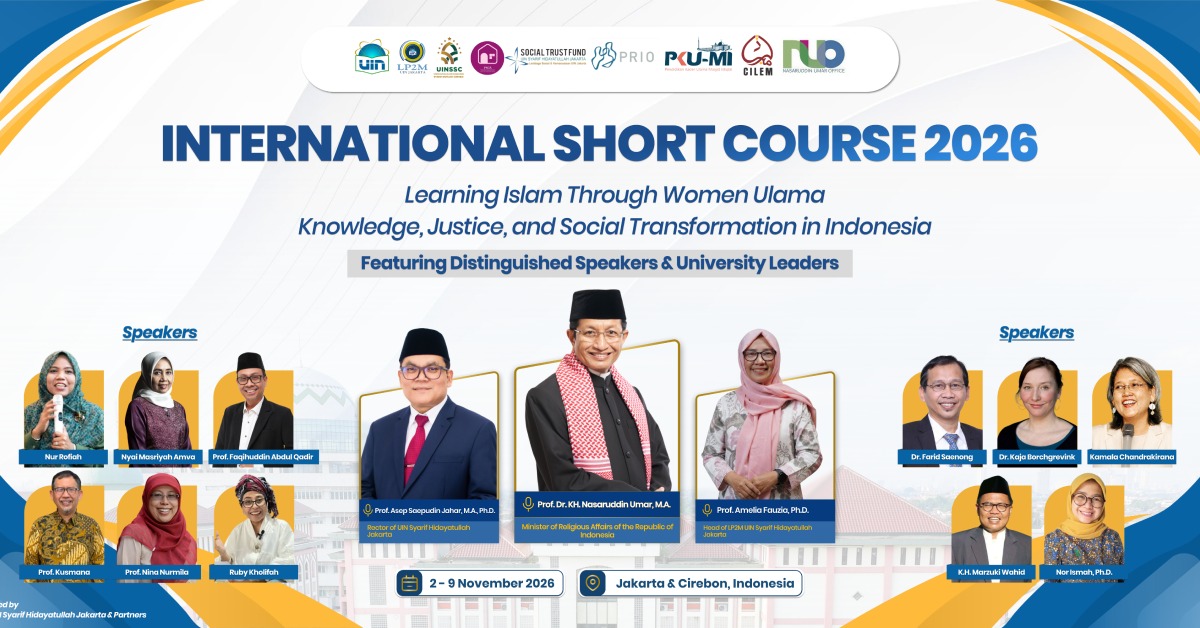
FITK Meeting Room, UIN Jakarta Online News – UIN Jakarta has concluded its International Short Course, Learning Islam Through Women Ulama: Knowledge, Justice, and Social Transformation in Indonesia, held from November 2 to 9, 2026. The program brought together international scholars, researchers, and students to explore the contributions of women ulama to Islamic scholarship, gender justice, and social transformation in Indonesia.
Organized by UIN Jakarta's Institute for Research and Community Engagement (LP2M), the program was conducted in collaboration with several national and international institutions. Its closing ceremony took place at the second-floor meeting room of the Faculty of Educational Sciences (FITK), UIN Jakarta, on Monday (11/09/2026).
The short course was a collaborative initiative involving LP2M UIN Jakarta, UIN Siber Syekh Nurjati Cirebon, the Istiqlal Mosque Ulama Cadre Education Program (PKUMI), the Indonesian Women's Ulama Congress (KUPI), the Social Trust Fund (STF) UIN Jakarta, and the Peace Research Institute Oslo (PRIO), Norway.
The closing event featured several academic leaders and researchers, including UIN Jakarta Vice Rector for Cooperation and Institutional Affairs Din Wahid, M.A., Ph.D.; LP2M Chair and Program Committee Chair Prof. Amelia Fauzia, Ph.D.; and PRIO Senior Researcher Dr. Kaja Borchgrevink. Also contributing to the program were UIN Jakarta Professor Kusmana, S.Ag., M.A., Ph.D., and researcher Lutfiana Dwi Masyasari.
In his remarks, Din Wahid highlighted the short course as an important platform for understanding women's rights, agency, and contributions to Indonesian society, particularly through the growing presence of women ulama institutions. He noted that global interest in the relationship between Islam and gender continues to grow, and Indonesia has valuable experiences and distinctive models to share with the international academic community.
"Today, there is growing recognition of women's rights and their important role in society. This program offers an opportunity to explore Islam through the perspectives and scholarship of women ulama. We are witnessing an increasing number of female Islamic preachers, or daiah, who are bringing perspectives that challenge conventional narratives," he said.
Din also emphasized that gender studies in Indonesia have a strong historical foundation, including pioneering critical scholarship on misogynistic interpretations of hadith. Reflecting on his own academic experience, he recalled attending a course on women and conflict resolution in Belfast, Northern Ireland, in 2006, alongside Prof. Dr. Hj. Siti Ruhaini Dzuhayatin, M.A.
He observed that in conflict-affected communities, women are often among the strongest advocates for peace. Their experiences of carrying domestic responsibilities and safeguarding their families' well-being give them a particular stake in preventing violence and sustaining peace.
"Women's contributions to peacebuilding deserve the highest recognition. I hope the academic papers produced by the participants will soon be published in reputable journals, with guidance from the distinguished professors here. Congratulations on the successful completion of this program," he added.
Meanwhile, Prof. Amelia Fauzia explained that the program brought together 18 participants, most of whom held master's or doctoral degrees, from diverse academic and national backgrounds. Over eight days, the short course combined intensive lectures, critical discussions, field visits, and research activities involving direct engagement with local communities.
"Some participants are researchers based in Jakarta, while others are students from Algeria, the Philippines, Morocco, Pakistan, and The Gambia. Throughout the eight-day program, they engaged in an interactive learning process that combined lectures, discussions, field observations, and hands-on research," she explained.
Amelia also praised the participants for their commitment to translating their field experiences into academic papers and research articles. These works were subsequently presented and reviewed by senior scholars in their respective fields. She emphasized that the interaction between international and Indonesian participants was an important part of the learning experience, with the broader aim of nurturing scholars who can contribute to meaningful social change.
"Over the eight days, participants developed and presented their papers and articles. We are particularly pleased with the strong interaction between international and local students. We hope they will become agents of change—not simply by learning theories from Islamic educational institutions and pesantren, but by bringing their knowledge back to society and making a tangible difference," she said.
She further noted that the short course adopted an inclusive and academically rigorous approach to learning. Participants were encouraged to express their views openly, particularly after examining how academic theories relate to realities encountered in local communities.
"What we observed during the field activities provided concrete examples for academic reflection. This does not mean that everyone has to agree on every issue. Rather, engagement with realities on the ground gives us a solid basis for analysis and objective assessment. The lecturers and resource persons involved in this program demonstrated outstanding academic quality. I hope opportunities for this kind of academic engagement will continue to expand, given their substantial intellectual and practical value," Amelia said.
From the international perspective, PRIO Senior Researcher Dr. Kaja Borchgrevink highlighted the value of experiential learning and direct field observation in developing a deeper understanding of gender justice. She noted that engaging with Islamic educational institutions and local communities offered insights that could not be obtained through textual research alone.
"The journey from Istiqlal Mosque, through the Tunnel of Tolerance, and into the everyday life of a pesantren was far more meaningful than we had anticipated. Spending time directly within these communities created remarkable learning opportunities, even within a relatively short period. Rather than relying solely on theories and academic literature, we gained a much more tangible understanding of how gender justice is understood and practiced within Indonesia's local Muslim communities," she said.
In her closing remarks, Kaja underscored the importance of international academic collaboration in addressing questions of gender and Islam. She viewed initiatives such as this short course as essential in bringing together people from different backgrounds and perspectives to foster more inclusive understandings of complex social and religious issues.
"I believe this short course on gender justice and women ulama organized by UIN Jakarta is extremely important. It brings people together and helps deepen our understanding of issues that can sometimes be sensitive and difficult to address, but are nevertheless essential to explore. I believe the best way to develop that understanding is through learning together," she concluded.
UIN Jakarta has a longstanding commitment to gender studies, dating back to its years as the State Institute for Islamic Studies (IAIN). With support from the Ministry of Religious Affairs and the Canadian International Development Agency (CIDA), Women's Studies Centers (Pusat Studi Wanita/PSW) were established across State Islamic Religious Universities (PTKIN) as part of broader efforts to advance gender-related research and scholarship.
Over time, these initiatives have evolved into the Center for Gender and Child Studies (PSGA), alongside the establishment of UIN Jakarta's Task Force for the Prevention and Handling of Sexual Violence (Satgas PPKS). Together, these institutions continue to strengthen the university's commitment to inclusive policies, gender equality, and social justice.