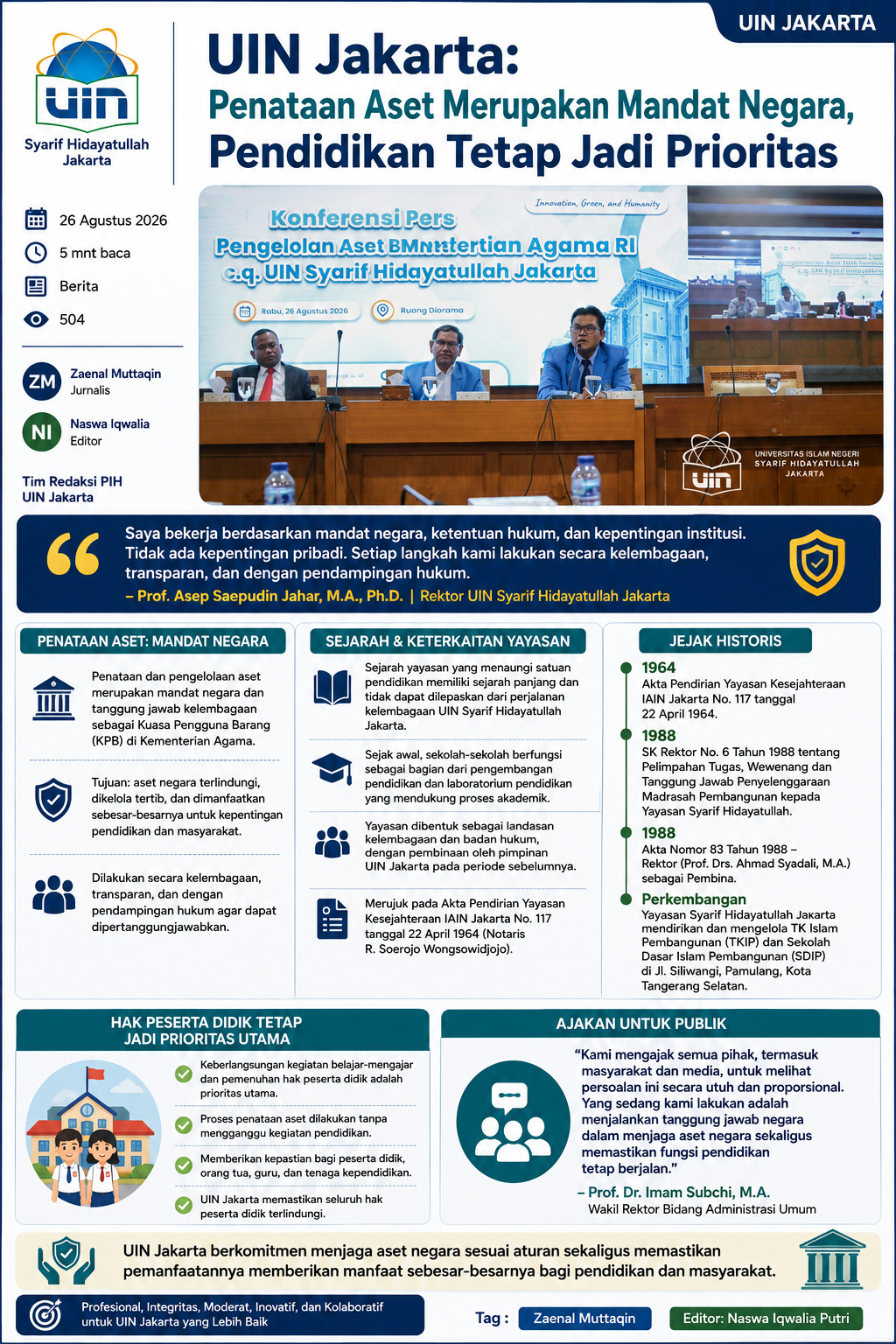
UIN Jakarta: Asset Management Is a State Mandate, Education Remains the Priority
Rectorate Building - Rector of UIN Syarif Hidayatullah Jakarta Prof. Asep Saepudin Jahar, M.A., Ph.D. emphasized that the measures taken to structure and manage assets within UIN Jakarta are part of a state mandate and institutional responsibility as the Property User Representative (KPB) within the Ministry of Religious Affairs.
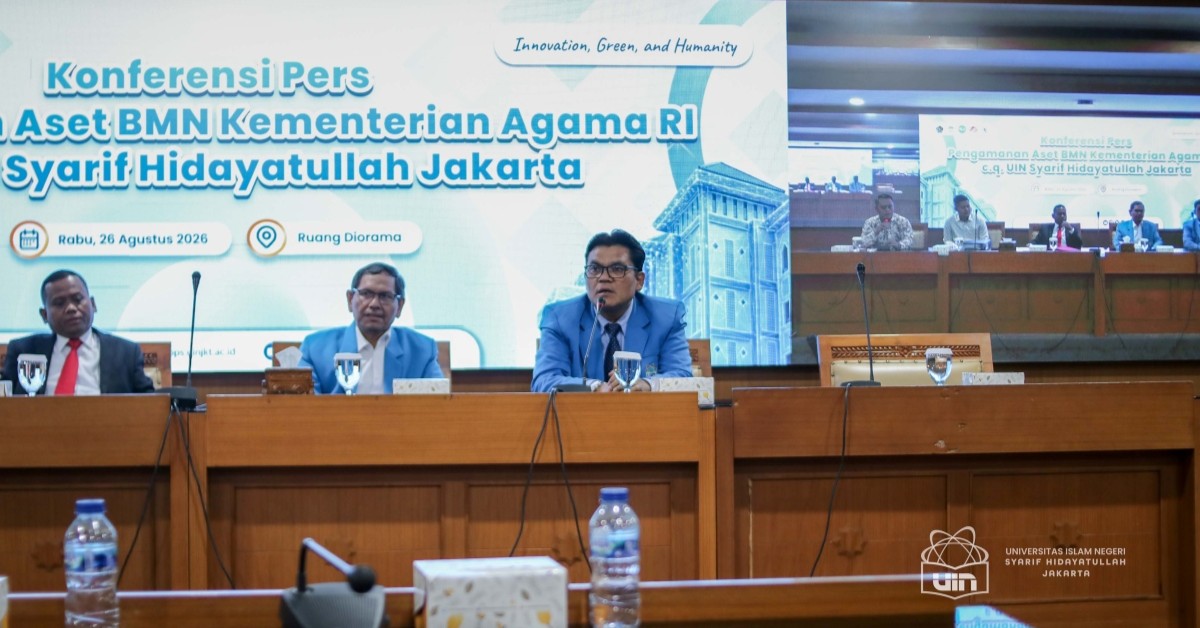
This affirmation was delivered by the Rector during a press conference at UIN Syarif Hidayatullah Jakarta, Wednesday (26/8/2026), following growing information and media reports regarding the management of several assets and educational units that hold historical ties with UIN Jakarta.
“I want to emphasize that as Rector, I work based on state mandates, legal provisions, and the interests of the institution. There are no personal interests in this process. Every step we take is conducted institutionally, transparently, and with legal guidance so that the entire process can be held accountable,” Prof. Asep asserted.
According to him, the mandate is part of the Rector's responsibility as the Property User Representative (KPB) within the Ministry of Religious Affairs of the Republic of Indonesia. Therefore, every policy implemented is directed toward ensuring that state assets are protected, orderly managed, and utilized to the fullest extent for the benefit of education and public service.
“As long as I hold the mandate as Rector of UIN Syarif Hidayatullah Jakarta, I am responsible for safeguarding state assets, managing them according to regulations, and ensuring their utilization provides maximum benefit for education and the public,” he said.
Prof. Asep explained that the asset structuring regarding educational units is carried out while keeping the continuity of teaching and learning activities and the fulfillment of students' rights as top priorities. “The teaching and learning process within the school environment remains our priority,” he stated.
Vice Rector for General Administration of UIN Jakarta Prof. Dr. Imam Subchi, M.A. added that the existence of foundations and educational units within UIN Jakarta needs to be viewed both legally and historically. “First, from a historical perspective, we need to clarify that the foundation overseeing these educational institutions has a long history that cannot be separated from the institutional journey of UIN Syarif Hidayatullah Jakarta,” he emphasized.
Vice Rector Imam explained that from the beginning, the presence of these educational institutions was closely tied to the needs of higher education institutions to provide educational and learning facilities for students. At that time, these schools also functioned as part of educational development and served as educational laboratories supporting academic processes.
“Initially, these schools functioned not only as educational institutions, but also as part of academic development and educational laboratories that supported the learning process,” he said.
Because operating educational units requires an institutional foundation and legal entity, he continued, a foundation was formed, which throughout history underwent developments, including changes in management structure. During this journey, several former UIN Jakarta leaders had also served supervisory functions within the foundation.
“Throughout that journey, several UIN Jakarta leaders served supervisory roles within the foundation, including previous Rectors of UIN Jakarta. This demonstrates that the relationship between the foundation and UIN Jakarta has a long institutional history,” he explained.
Referring to data from the legal team, the history of educational units within UIN Jakarta points, among others, to the Deed of Establishment of the IAIN Jakarta Welfare Foundation No. 117 dated April 22, 1964, executed before R. Soerojo Wongsowidjojo, Notary in Jakarta.
In its institutional journey, provisions regulated the connection between the Rector of IAIN Jakarta and the foundation's supervisory structure. The Rector of IAIN Jakarta was designated as the ex-officio Chairman of the Board of Trustees, while the Vice Rectors served as trustees, and the Dean of the Faculty of Tarbiyah served as the ex-officio Chairman of the foundation's Management Board.
These historical ties subsequently evolved through a series of institutional policies. One of them was Rector's Decree No. 6 of 1988 concerning the Delegation of Duties, Authority, and Responsibility for the Operation of Madrasah Pembangunan IAIN Syarif Hidayatullah Jakarta to the Syarif Hidayatullah Foundation. In that document, the Rector on behalf of Prof. Drs. Ahmad Syadali, M.A. was recorded as a Trustee in accordance with Deed No. 83 of 1988.
In subsequent developments, the Syarif Hidayatullah Jakarta Foundation also established and managed several educational units, including the Pembangunan Islamic Kindergarten (TKIP) and Pembangunan Islamic Elementary School (SDIP) located on Jalan Siliwangi, Pamulang, South Tangerang City. Previously, the Syarif Hidayatullah Jakarta Foundation also oversaw Madrasah Pembangunan, which functioned as a lab school for the Faculty of Tarbiyah and Teacher Training at IAIN Syarif Hidayatullah Jakarta (now UIN Jakarta).
Students' Rights Remain the Top Priority
Furthermore, both Rector Asep Jahar and Vice Rector Imam emphasized that the most crucial aspect in this structuring process is ensuring the continuity of the students' education. Both assured that UIN Jakarta places the fulfillment of students' rights as a priority amid asset and institutional structuring efforts.
This is done by ensuring that all teaching and learning processes continue in an orderly manner, providing certainty for students, parents, teachers, and educational staff. “Our primary concern is the continuity of education. Asset and institutional structuring must be carried out while ensuring teaching and learning activities run smoothly and students' interests are protected,” Imam stressed.
Furthermore, Vice Rector Imam invited all parties, including the public and media, to view the issue holistically, objectively, and proportionally. “We also invite all parties, including the public and the media, to view this matter holistically and proportionally. What we are doing is carrying out the state's responsibility in protecting state assets while ensuring the educational function continues to operate,” he urged.