
The Cost of Fixing Indonesia’s Failing Rupiah
Mohammad Nur Rianto Al Arif
Professor at UIN Jakarta
In an increasingly volatile global landscape, the Indonesian Rupiah has once again become the center of financial scrutiny. A currency’s exchange rate is more than just a flickering digit on a forex screen; it is a barometer of market confidence, economic resilience, and the surgical precision of a central bank’s monetary policy.
In recent months, the Rupiah has faced escalating pressure born from a toxic cocktail of external shocks. Anything you can name such as geopolitical flares in the Middle East and the higher-for-longer interest rate regime in the U.S. coupled with domestic fiscal demands. In this high-stakes environment, Bank Indonesia (BI) faces the ultimate dilemma: how to stabilize the currency without suffocating national economic growth.
Bank Indonesia’s mandate is clear: maintain the stability of the Rupiah regarding both inflation and the exchange rate. Under its Inflation Targeting Framework, BI does not dogmatically defend a specific price point. Instead, stability is defined as the ability to dampen excessive volatility while ensuring the exchange rate remains aligned with economic fundamentals. Therefore, a controlled depreciation is not necessarily a policy failure, provided it does not trigger a domino effect on inflation or the broader financial system.
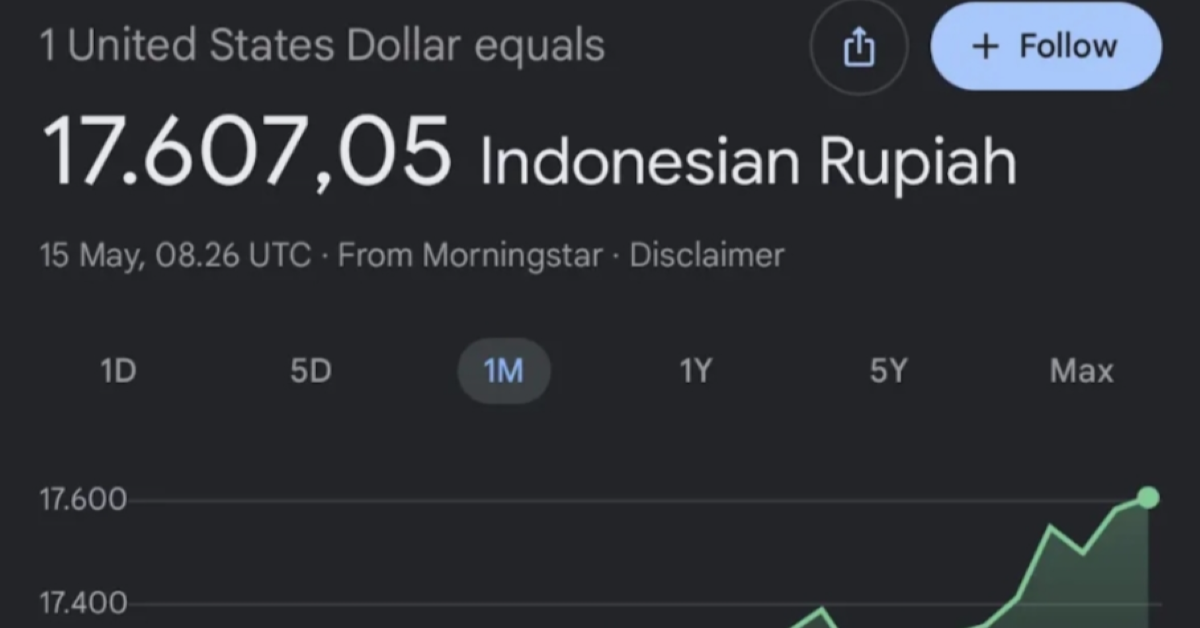
However, as of May 13, 2026, the reality is stark. The Rupiah closed at Rp 17,475 per USD. While this represented a slight 0.30% gain from the previous day, the broader trend remains a steep uphill battle for the central bank.
The Triple-Pillar Strategy: The "Policy Mix"
To combat this, BI has moved beyond simple interest rate adjustments, deploying what it calls a "Policy Mix." This strategy rests on three primary pillars:
-
The Interest Rate Dilemma: BI has chosen to maintain its benchmark rate (BI-Rate) at 4.75% throughout 2026. This is a classic central bank tightrope walk. Keeping rates high attracts foreign capital to bolster the Rupiah, but it risks crushing domestic investment. With U.S. interest rates remaining stubbornly high, the "interest rate differential" has shrunk, making Rupiah-denominated assets less attractive despite BI's best efforts.
-
Triple Intervention: BI actively intervenes in the spot market, Domestic Non-Deliverable Forward (DNDF), and the offshore NDF market. While this has successfully smoothed out short-term spikes, intervention is inherently defensive. It can slow the bleeding, but it cannot heal the wound if the fundamental pressure remains too strong. Furthermore, aggressive intervention risks eroding foreign exchange reserves, which currently sit at a relatively safe $148.3 billion.
-
Macroprudential and Administrative Measures: BI has tightened regulations on USD purchases to curb speculative trading. While this provides a psychological boost and reduces non-essential demand for dollars, it remains a temporary fix. Without structural repairs, the pressure will eventually find a new vent through capital outflows or increased import demand.
Is BI’s policy effective? The answer is nuanced. In the short term, BI has retained its credibility. Volatility is managed, and extreme panics have been averted through measured interventions. Market expectations remain anchored because the central bank is seen as a proactive and credible actor.
However, in the long-term trend, the effectiveness is questionable. The Rupiah remains one of the weaker performers in the Asian region for 2026. This highlights a hard truth: monetary policy alone cannot stop a global storm. Factors like the U.S. Federal Reserve’s decisions and global geopolitics exert a gravity that no single emerging market bank can fully escape. There is an inevitable trade-off; stabilizing the currency often comes at the expense of the real economy, as high rates dampen consumption and a weak currency inflates the cost of imports.
The Path Forward: Beyond the Central Bank
Stability cannot be the sole burden of the central bank. Finance Minister Purbaya Yudhi Sadewa has signaled a synchronized effort, utilizing the bond market to assist in currency stabilization. But for true resilience, Indonesia must address its structural dependencies:
-
Strengthening Fundamentals: Moving from raw commodity exports to high-value-added products to reduce import dependency.
-
Deepening Domestic Financial Markets: Reducing reliance on fickle foreign capital by building a more robust domestic investor base.
-
Monetary-Fiscal Synergy: Ensuring that the government’s spending and BI’s tightening are not working at cross-purposes.
Bank Indonesia has been quick, measured, and credible in its response to the 2026 currency crisis. Yet, the sheer scale of global disruption leaves little room for maneuver. Stabilization, in this context, is more akin to "holding back a wave" than "stopping the storm." It is a vital defensive act, but it is not enough. Without deep economic reforms, the stability achieved remains a "hollow stability"—calm on the surface, but fragile underneath. In 2026, the exchange rate remains the ultimate reflection of a nation’s true economic strength.
This article was published in Kompas on Friday (15/5/2026).