
Religion and Pancasila: Partners or Opponents?
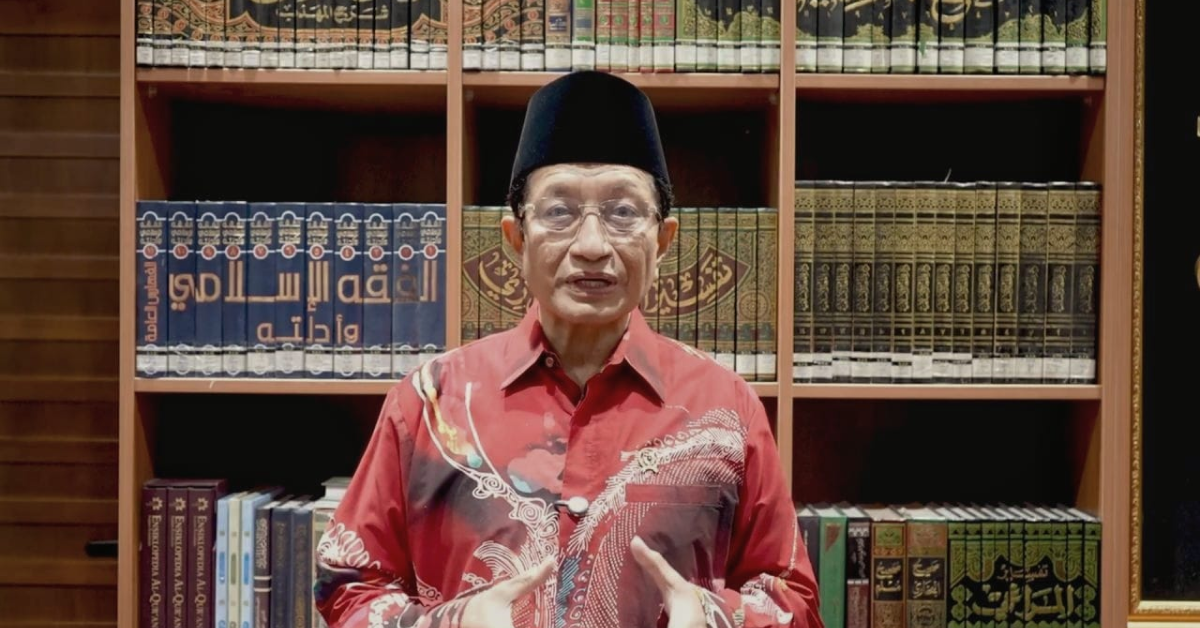
Nasaruddin Umar
(Professor of Qur’anic Exegesis, Faculty of Ushuluddin, UIN Syarif Hidayatullah Jakarta,
Minister of Religious Affairs of the Republic of Indonesia)
Religion and Pancasila are like a pair that strengthens one another. Both must provide guidance and enlightenment to all citizens without exception.
Religion and Pancasila cannot be set against each other. Religion should enlighten its followers so they can accept and appreciate the noble values of Pancasila. On the other hand, Pancasila must also protect all religious communities, including those who choose not to follow a religion or adhere only to belief systems.
Religion is directed to support the goals of the state without setting aside its own principles. In the Unitary State of the Republic of Indonesia, this function has been proven for decades. Religion can contribute to achieving national goals without losing the substance of its teachings. In fact, religious teachings can accelerate the achievement of national development goals and the creation of a fully developed Indonesian society.
Religion also promises peace, wisdom, justice, and tranquility to its followers. However, this can only happen if religion is given an effective role in enlightening its people.
The question now is, who is responsible for actualizing this enlightening function of religion in society? The effectiveness of religion can be measured by the role and participation of its leaders and followers. If religion becomes more integrated with its followers, it means its enlightening function is effective. On the contrary, if religion and its followers grow more distant, it signals ineffectiveness. Especially if religious and state values are in conflict—this clearly indicates something is wrong, contradicting the foundational concepts established by our founding fathers.
This can also be observed in society: what religion teaches versus what its followers actually do. Are they aligned? Are they in line with the programs set by the 1945 Constitution and other legal frameworks?
If they are still in opposition—for example, if national development programs conflict with religious teachings, or if religious teachings do not align with or even hinder national goals—then there is a conceptual problem that must be addressed immediately. Otherwise, both may stand in opposition, ultimately confusing society.
In reality, we are witnessing an unsettling phenomenon. There are contradictory patterns in society regarding the relationship between religion and its followers. There is indeed a visible increase in religious expression, but it is not accompanied by deeper understanding and meaning.
As a result, we often see what can be described as a split personality among religious communities, particularly among Muslims.
Muslims often find themselves at a crossroads. In religious matters, religion is perceived as overly dogmatic, while social reality feels highly rational. Religion seems restrictive, while daily life feels increasingly liberal.
Religion is seen as oriented toward the past, while professional environments are future-oriented. Religious institutions are perceived as conservative, while workplaces are highly advanced. Religious norms appear static and rigid, while the working world is dynamic and mobile. Religious inner life feels traditional, while social interactions in daily life are modern.
Religious studies are often viewed as too textual, while general sciences are highly contextual. Religious approaches are seen as qualitative and deductive, while social sciences are quantitative and inductive.
According to Clifford Geertz, this split personality can lead to various outcomes, including sporadic or gradual reform, radical or liberal reform, puritan revivalism, radical revivalism—including extremism—or even a complete lack of awareness of what is happening beyond oneself.
This article was published in Kompas on Wednesday, March 18, 2026.