
In Assisi Speech, Religious Leaders Worldwide Back Indonesian Minister’s Vision for Faith-Based Diplomacy
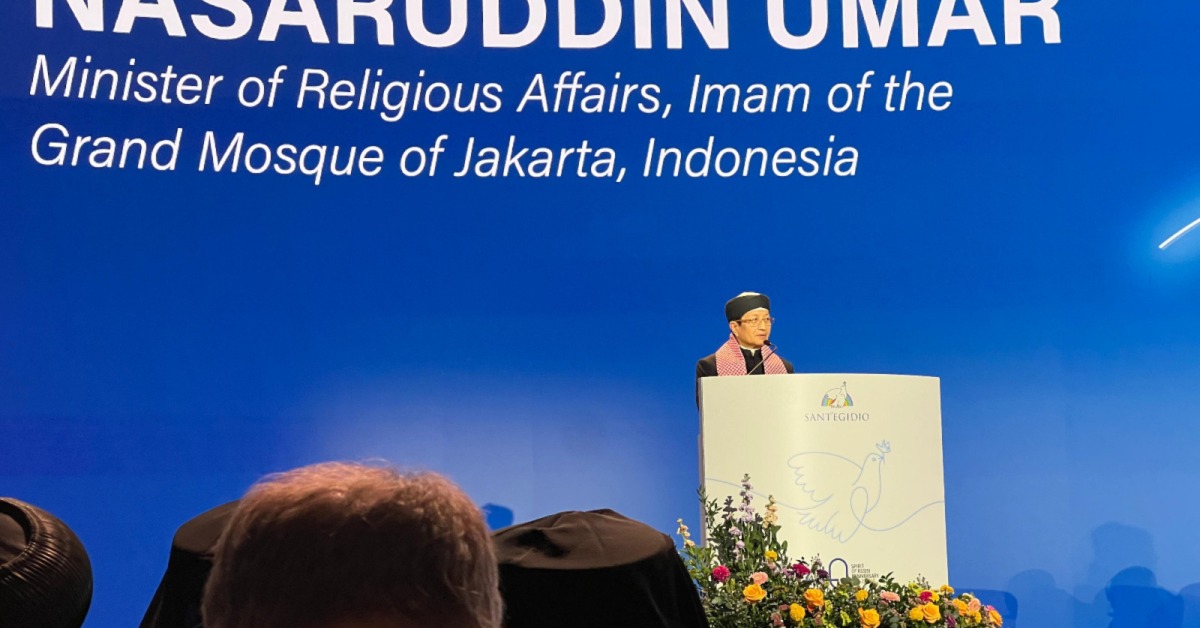
Assisi, UIN News Online — Indonesian Minister of Religious Affairs and Grand Imam of Istiqlal Mosque, Prof. Dr. K.H. Nasaruddin Umar, M.A., has received strong support from religious leaders worldwide for his vision of prioritizing concrete humanitarian action. He presented this vision at the Sant’Egidio International Meeting for Peace in Assisi, Italy.
Speaking at the high-level opening session titled “Opening Assembly – Unarmed and Disarming Peace,” Minister Nasaruddin called for a paradigm shift in global diplomacy, urging that interfaith relations be translated into concrete initiatives with a direct impact on communities. His proposal received a positive response and further endorsement from prominent international religious figures attending the gathering.
Addressing a forum attended by hundreds of delegates from various countries, the minister highlighted the limitations of traditional interfaith summits, which often become preoccupied with symbolic gestures. He argued that global harmony requires practical, targeted measures that directly benefit communities.
“Interfaith dialogue must not stop at formal joint declarations, signatures, or agreements on paper,” Minister Nasaruddin Umar stressed in Assisi on Tuesday (October 27, 2026).
Accompanied at the Assisi meeting by Adiyarto Sumardjono, Senior Advisor to the Minister of Religious Affairs and Acting Director General of Catholic Community Guidance, the minister emphasized that genuine peace requires dialogue to be actively translated into concrete action and environmental conservation initiatives that directly ease the burdens faced by grassroots communities.
Minister Nasaruddin urged world leaders to begin adopting the “language of religion” as a core mechanism in international relations. He argued that a spiritual framework can help reduce deeply rooted psychological hostility, particularly when conventional political and military maneuvers reach an impasse.
As a concrete example, the minister presented Indonesia’s model of pluralism and living harmony as a case study demonstrating how diversity can be managed to maintain stability and foster peaceful coexistence in everyday life. This endorsement further underscores Indonesia’s active role in promoting religious moderation (Wasatiyyah Islam) and cross-border harmony on the global stage.
The minister’s vision of practical diplomacy was welcomed and reinforced by religious leaders attending the meeting. Cardinal Matteo Zuppi, President of the Italian Bishops’ Conference, supported the call to overcome rigid, aggressive, and conflict-driven mindsets. He also agreed that religious institutions must actively work to disarm hostility through cross-border cooperation and advocacy that uphold human dignity.
Similar support came from Chief Rabbi Haim Korsia, the Chief Rabbi of France, who emphasized the importance of moving beyond ceremonial gestures. He affirmed that cooperation among religious leaders on local humanitarian projects builds a far stronger foundation for peace than political agreements alone.
Representatives of Eastern Orthodox Christianity and the ecumenical movement also welcomed Indonesia’s model of pluralism. They pointed to the 2024 Istiqlal Declaration, signed by Minister Nasaruddin and Pope Francis in Jakarta, as a blueprint demonstrating that significant theological differences need not lead to conflict.
The opening session concluded with a shared commitment among all panelists to carry forward the “Spirit of Assisi 1986,” transforming dialogue forums into practical instruments of international diplomacy focused on humanitarian action, environmental conservation, and sustainable world peace. (zm)