
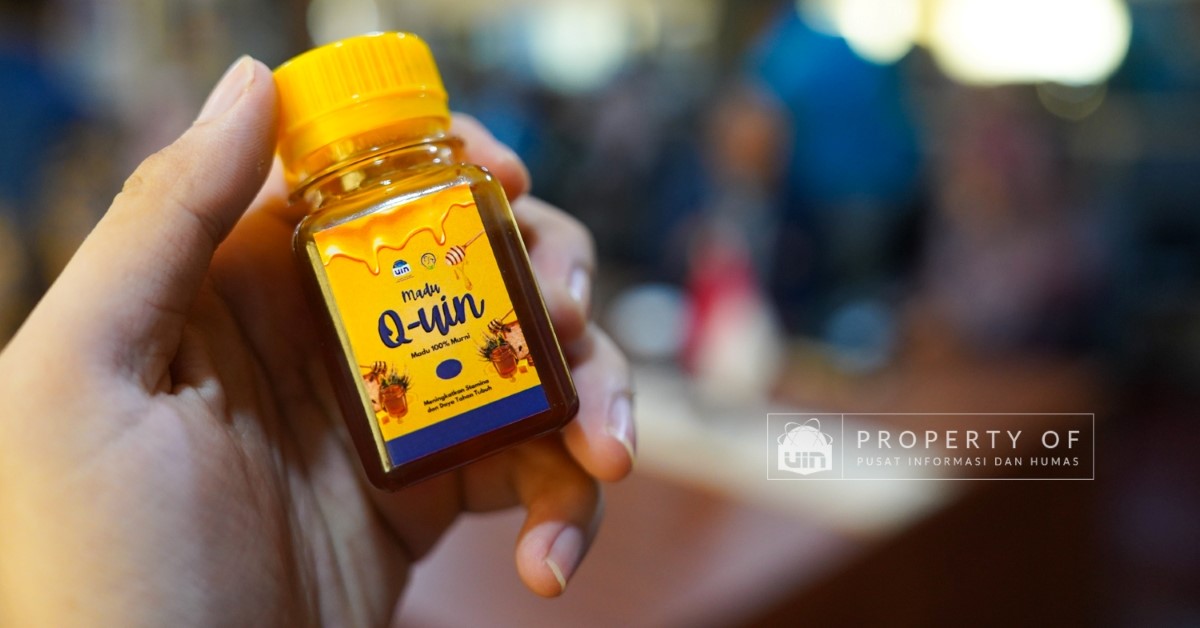
Driving Biotech Commercialization, The Faculty of Science and Technology Brings Q-uin Honey to Deter Counterfeits
JAKARTA, UIN Online News – Transitioning laboratory research into high-value commercial assets, the Research Team of the Faculty of Science and Technology (FST) at UIN Jakarta, led by Professor La Ode Sumarlin, M.Si., officially launched "Madu Q-uin" on Wednesday, July 1, 2026. Developed under a strategic joint venture with corporate industrial partners, the innovative biotech product represents a major breakthrough in downstream academic research, converting years of rigorous scientific testing into a market-ready health commodity.
The commercialization project directly targets the urgent national demand for strict quality control and product authenticity within the consumer health sector.
To ensure absolute market competitiveness, the product formulation strictly adheres to the newest state regulation, SNI 8664:2024, which governs the national standard and requirements for pure honey authenticity. Corporate Research Partner, Dr. Mahani, M.Si., detailed the specific scientific parameters embedded in the Q-uin quality assurance pipeline to filter out fraudulent or adulterated honey products currently flooding the Indonesian market.
"The primary operational indicator for purity is moisture control," Dr. Mahani explained during the technical briefing. "Under the SNI 8664:2024 mandate, standard pure honey must maintain a maximum moisture level of 22 percent, while premium Trigona (stingless bee) honey is legally capped at a maximum of 27 percent."
Beyond standard moisture testing, the UIN Jakarta research team utilizes electrical conductivity metrics as the ultimate forensic barrier to expose sugar-adulterated honey (madu oplosan). This biophysical test serves as the product’s core intellectual property advantage in the commercial space.
"If the electrical conductivity of a honey sample drops below the threshold of 800 microsiemens, it serves as an immediate, undeniable indication that the product has been heavily diluted with commercial sugar syrups," Dr. Mahani revealed.
The scientific rationale relies on the fact that processed sugar possesses extremely low electrical conductivity. Conversely, unadulterated pure honey naturally retains a high concentration of minerals and electrolytes, demanding a minimum electrical conductivity score of 800.
By mastering the complex pathway of downstream research, FST UIN Jakarta aims to establish a sustainable model where academic faculty members can continuously license their scientific innovations to industrial clusters. Backed by its high-quality composition, distinct branding, and rigorous scientific validation, corporate stakeholders express high optimism that "Madu Q-uin" is structurally positioned to become a dominant, highly viral premium honey brand in the Indonesian domestic market.
(Nosa/Zaenal/Arifin/Photo: Azka Raysa)